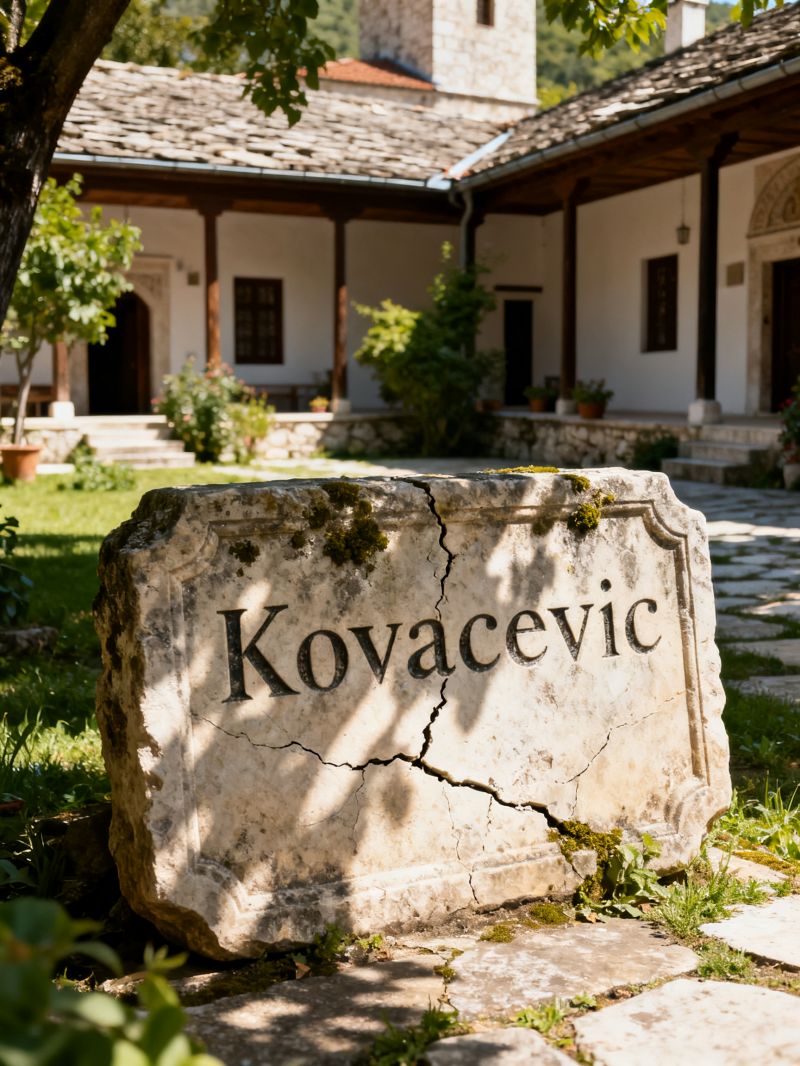
You won't find Kovacevic in the index of most standard histories, yet the name keeps surfacing in unexpected corners—a footnote in a diplomatic cable from 1993。a line item in a Bosnian court transcript, a faded byline on a architectural review from 1970s Belgrade. I first encountered it on a crumbling plaque in a Sarajevo courtyard, the kind of place where the past hasn't just been forgotten;it's been aggressively overwritten. That plaque, dedicated to a "Kovacevic, engineer," offered no first name, no dates. Just the surname and a profession. It felt less like a memorial and more like a dare.Tracking Kovacevic is a lesson in the limits of record-keeping. The surname itself is a mountain range of variants—Kovačević, Kovacevich, Kovachevic—each spelling a different branch on a family tree that splintered across the Habsburg-Ottoman frontier and, later。
the Yugoslav wars. I spent two days in a Zagreb archive chasing a "Vladimir Kovacevic" who turned out to be a typo for a completely different military engineer. The real Kovacevic, if there is one, slips through these cracks. A Sarajevo radio operator named Amra Kovacevic told me she stopped correcting people's pronunciation decades ago. "They hear what they want," she said. "A Croat hears a Croat. A Serb hears a Serb. I just hear my father's voice." That's the central tension: Kovacevic as a Rorschach test for Balkan identity, a name that refuses to stay in its lane.There's a temptation to frame this as tragedy, and it's not wrong—the Kovacevics listed in the 1992-95 casualty databases number in the dozens。scattered across all three ethnic factions. But that's the tidy, external view. Less examined is the quieter, stranger persistence. In Vienna, a young composer named Luka Kovacevic is setting folk laments to electronic noise, describing his work as "a conversation with dead relatives I never met." In Chicago, the Kovacevic family runs a Serbian Orthodox bookstore that, by the owner's own admission, does more business selling diaspora nostalgia than actual books. These aren't stories of victimhood or triumph. They're stories of stubborn, unglamorous continuity—people who keep a name alive not because it's heroic, but because it's theirs. I'd argue that's a more honest legacy than any monument.The name's slipperiness has practical consequences. When I tried to trace property records for a Kovacevic in Mostar, the municipal clerk laughed. "Which one?" she asked. "The one who left, the one who stayed, or the one who came back and left again?" The paper trail, she explained, is a palimpsest of wartime displacements and postwar claims, each layer contradicting the last. Kovacevic, in this context, isn't a person but a category of legal ambiguity. It's a bureaucratic nightmare that happens to have a human face. And yet。the clerk herself was a Kovacevic—her mother's maiden name—a detail she volunteered with a shrug, as if to say: see?it's everywhere and nowhere.
Maybe that's the only conclusion worth drawing. Kovacevic resists the neat narrative arc that SEO editors and foreign correspondents crave. It doesn't resolve into a single, digestible lesson about reconciliation or loss. It's a name that has been beaten into a dozen different shapes by history。and it still doesn't fit cleanly into any of them. The plaque in Sarajevo is still there, I checked. Someone has scrawled a question mark next to the engineer's surname in black marker. A vandal, or perhaps a relative. I choose to read it as a conversation starter, because with Kovacevic, that's all you ever really get.